Prajna Discourse
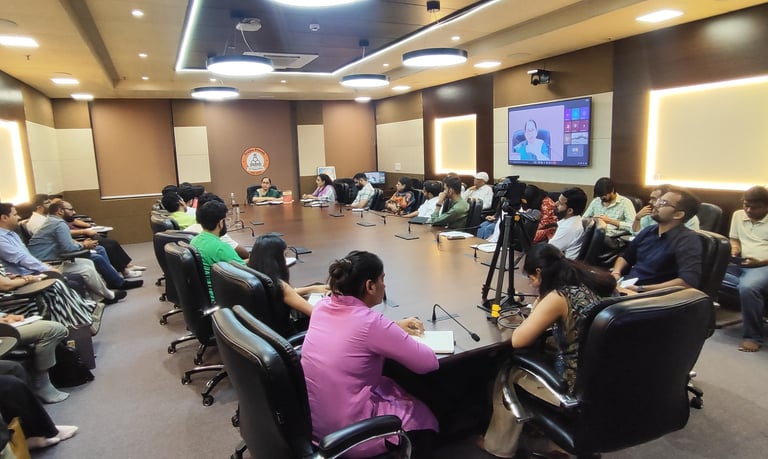
Prajna Discourse is a monthly lecture cum discussion series organized by Prabodh Jnana Kendra to foster multidisciplinary intellectual discussions under the broader theme of Swa - Hindutva - Bharat.
These are aimed at thought provoking reflections on India’s civilizational values, cultural heritage, and contemporary challenges.
Core Objectives:
Understanding Swatva : Introspecting and exploring the Swatva of Bharat.
Academic and Intellectual Engagement: Creating a vibrant intellectual ecosystem among young scholars.
Knowledge Dissemination: Creating a space for knowledge exchange and dissemination for professionals of every field.
300+
Speakers
Scholar Attendees
6
Session Archive
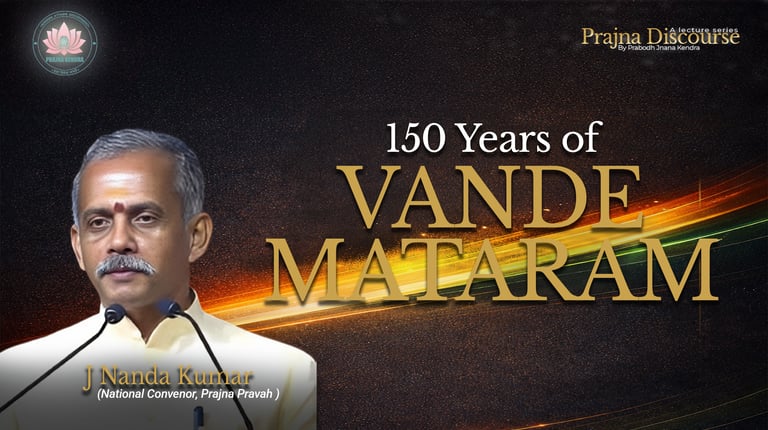
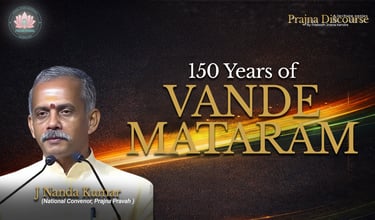
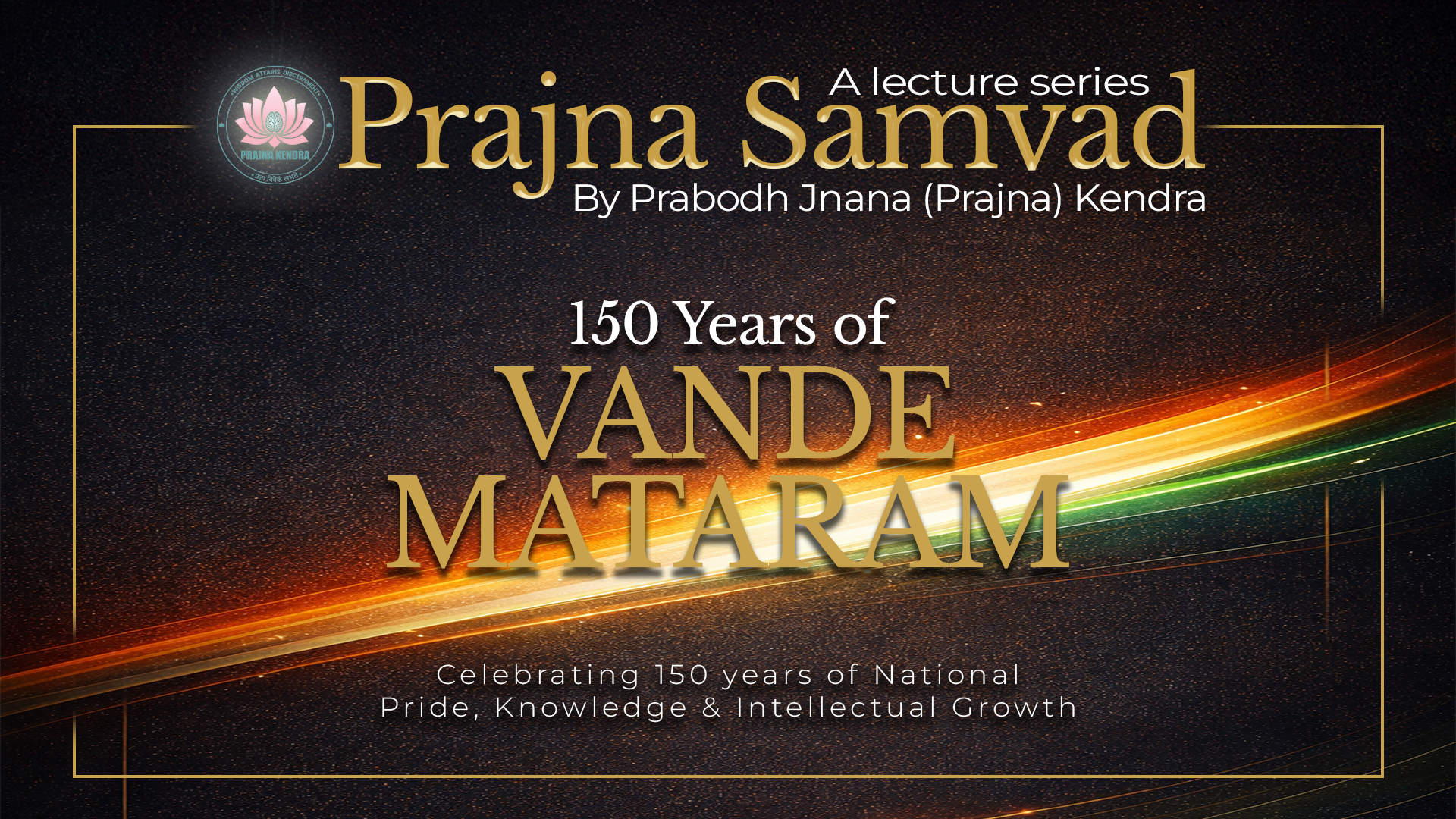
150 Years of Vande Mataram
The lecture highlights the significance of the Hindu Mela, initiated by Nabagopal Mitra and Rajanarayan Basu, as a crucial nursery for national consciousness that influenced great figures like Rabindranath Tagore and Swami Vivekananda. It details Bankim Chandra Chattopadhyay’s literary contributions, particularly works like Durgesh Nandini and Anandamath, explaining how he used literature as a medium to manifest national identity and how his characters in Anandamath embodied the ideals of sacrifice and resistance against British colonial rule. The overall message emphasizes that Vande Mataram awakened India’s spiritual nationalism and remains relevant today as a foundation for cultural identity and nation-building.
Understanding Hindutva
The speaker explains that in Sanskrit, the suffix '-tva' denotes the true nature, essence, or state of being of a word—just as humanity defines a human, or personality defines a person; therefore, Hindutva simply means "the essence or state of being a Hindu." However, the introduction highlights a sharp contrast between this linguistic definition and the prevailing sociopolitical narratives. For those outside this specific thought-circle, a highly negative narrative has been constructed, where being Hindu or identifying with Hindutva is often stereotyped as being communal, backward, anti-women, unscientific, and rigidly divided by caste discrimination.
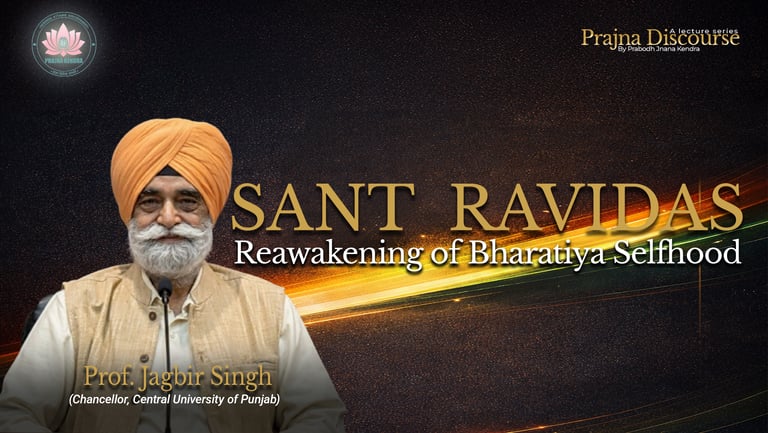
Sant Ravidas
In this thought-provoking session, Nidhi Tripathi examines the narratives influencing young Indians and explores how social media, media debates, storytelling, education, popular culture and wider social ecosystems can shape the way people think and interpret society. The discussion goes beyond the idea of a single “Indian youth” and looks at differences between rural, urban and metropolitan youth, highlighting how social and cultural realities can vary significantly across these groups.
Understanding Bharat
The session opens with a traditional Vedic invocation from the Rigveda, setting a spiritual and intellectual tone for an in-depth exploration of "Understanding Bharat." Delivered on the auspicious occasion of Buddha Purnima, the speaker emphasizes that comprehending Bharat requires looking beyond mere political, geographical, or statistical boundaries. Instead, the introduction establishes that Bharat must be understood as an eternal civilizational flow, a living cultural entity, and an organic vision rooted deeply in ancient texts like the Vedas, Upanishads, and the Gita. The foundational premise is that Indian thought offers a unique worldview centered around integrated cosmic order (Rita), consciousness, and universal values rather than fragmented or materialistic perspectives.
Hindutva: A Cultural Notion
This lecture provides a rigorous, multi-layered exploration of Hindu culture, tracing its evolution from core metaphysical inquiries into fully realized social, economic, and political structures. Moving away from superficial definitions, the discourse challenges contemporary Western paradigms of "Nation Building," arguing instead that the Indian civilization is fundamentally an inquiry-based civilization (Jiṅgāsa-mūlak sabhyatā) driven by a perennial quest for self-realization. Far from a rigid scriptural recitation, the speaker bridges ancient insights with modern realities, mapping out the intricate, living relationship between Shastra (sacred texts) and Lok (folk traditions).
Democratic System in Ancient Bharat


In this insightful lecture on “Democratic Systems in Ancient Bharat,” Prof. Bhagwati Prakash Sharma explores the rich traditions of governance and political thought found in ancient Bharatiya civilisation. Drawing references from the Vedas, Upanishads, Mahabharata, Arthashastra, Smritis, Puranas, and other ancient texts, the lecture examines various systems of governance, the election and appointment of rulers, the role of Sabha, Samiti and Parishad, village self-governance, ministerial councils, administrative procedures, and the limitations placed upon the authority of kings.
Contemporary Narratives Among Bharatiya Youth
In this insightful and profound lecture, renowned scholar Prof. Jagbir Singh Ji delves deeply into the medieval Bhakti movement, the resurgence of Indian consciousness (Svatva), and the revolutionary contributions of Sant Shiromani Guru Ravidas Ji. The video beautifully maps the journey of Indian civilization from its ancient roots, through the challenges posed by foreign invaders, to the spiritual and social renaissance led by India's revered saints. Is India just a geographical nation or a 'Civilizational State'? How is Indian culture inherently knowledge-centered and duty-based (Dharma-driven)? And how did Sant Ravidas Ji bring the profound non-dual philosophy of Vedanta to the common man? Watch the full video as Prof. Jagbir Singh Ji explores these profound thoughts.